DOGE Trump and Musk Creating Havoc

 By Tim Eisele

    “How many times can a man turn his head and pretend that he just doesn’t see. . . “ are words from a song by Bob Dylan and sung by many, including Peter, Paul and Mary.

If people who care about the environment and wildlife don’t stand up for public lands and the professionals working for us in natural resources, nobody else will!

    The chaos that President Donald Trump and Elon Musk have created, under the guise of rooting out inefficiencies and reducing Federal paychecks, will come home to haunt Wisconsin’s natural resources programs.

    Federal offices are being closed, Federal employees are unsure whether they have jobs, and programs dependent on Federal grants are on hold.

    Employees are fearful of the next e-mail message, morale is down the tubes, and talented young recruits who would be tomorrow’s conservation leaders are looking elsewhere.

    This is no skillful cutting of “fat” with a surgical knife, but more like a chain saw.  The intent is to gut Federal government.

    In addition, the current system of natural resources management, (best described as the North American Model of Wildlife Management), involves a unique cooperative approach of state, county, and federal organizations, along with many non-governmental organizations.  

    Wisconsin works in coordination with employees of the U.S. Forest Service, U.S. Natural Resources Conservation Service, U.S. Fish and Wildlife Service, Cooperative Wildlife Research Unit, Cooperative Fisheries Research Unit, Horicon National Wildlife Refuge, Necedah National Wildlife Refuge, Upper Mississippi National Wildlife and Fish Refuge, USGS National Wildlife Health Laboratory, Apostle Islands National Lakeshore, Waterfowl Production Areas, Genoa and Iron River National Fish Hatcheries, USDA Wildlife Services, and Farm Services Agency.

    Those Federal employees are concerned about their future employment, and their agencies have given orders not to talk to the press.

    Some project and probationary employees who have already lost their jobs, after being accused without documentation of substandard work, have told their stories.

    A forestry source in northern Wisconsin confirmed that on Valentine’s Day, 12 probationary employees on the Chequamegon-Nicolet National Forest were let go, along with another four from the Great Lakes Visitor Center in Ashland.

    The Milwaukee Journal Sentinel has reported that “about a half-dozen scientists were fired last month from the Upper Midwest Environmental Sciences Center” and these are people who work on invasive carp and ecosystem problems of the Upper Mississippi River.

    The Department of Governmental Efficiency, has closed a leased U.S. Fish and Wildlife Service office in Madison.

    Many who are still working will not talk fearing retaliation and job loss.

    The Wisconsin Waterfowl Association reports that it has signed contracts to do wetland habitat restoration work based on Federal grants, but now it has a lack of confidence that those agreements will be honored and the funds will be made available to pay the contractors.

    Other non-government organizations get grants from FWS for wetland projects and restoration, and they are concerned about what might be cut or delayed.

    More reductions are coming, as outlined in Project 2025 that was drafted prior to the presidential election.  What is expected are efforts to open refuges to oil and gas drilling, sell off public lands, and shrinking the Federal workforce.

    A future possibility is that the Senior Executive leaders such as those with National Wildlife Refuges, could be moved to other locations to encourage people to retire or quit.

State retirees CAN talk

    Tom Hauge, retired director of Wildlife Management for the Wisconsin DNR, said that, “If I were in Eric Lobner’s shoes (the current DNR director of wildlife management) right now I’d be very concerned about what these impacts will be on wildlife conservation in Wisconsin.”

    Wisconsin relies on grants from the Federal government, and in the last biennium the Department of Natural Resources (DNR) received over $200-million from the Federal government.

    Hauge, who also co-chairs of the Wisconsin Green Fire Wildlife Working Group, said the same goes for the DNR’s Bureau of Natural Heritage Conservation which receives State Wildlife grants from the Feds to help fund their work.

    “The first dismissals of folks on probationary status, which you might think of as young out-of-college folks, also includes people who were mid-career and changed from one job to another and were in that first year,” Hauge said.  

    Joshua Martinez is typical of a young person who lost his job after he had worked as a wildlife biologist for DNR and then took a new job with the U.S. Fish and Wildlife Service.  He “was fired for no reason of my own doing,” and is now trying to support his family of four.

    Hauge said that FWS distributes the excise tax reimbursements to the state, which in the last fiscal year was $27.7-million for wildlife, and for fisheries was $11.8-million.

    “A lot of that goes into habitat work, species monitoring, and staff positions,” he said. Whether those funds will be at risk is not known, but there has been a hold or slow-down on federal payments that is a concern, as the DNR spends the money first and then has to get reimbursed.

    Federal funds were used in many of the major wildlife programs, such as elk and wild turkey reintroductions.

    “This is part of the foundation of wildlife conservation in DNR,” Hauge said.

    The U.S.D.A. Aphis Wildlife Service is contracted by DNR to issue permits for landowners to deal with problem wildlife and if they don’t have the staff, it will take much longer to get permits for things like beaver control, bear trapping or Canada goose removal.

    Hauge said he heard this agency had lost 8 field positions, and wonders how this will affect service to landowners?

    The Natural Resources Conservation Service and Farm Services Administration works with private landowners on programs such as CRP and the voluntary public access program helping hunters access private land.

    There is concern about continued payments to landowners, but a spokesperson for NRCS said: “On February 20, Secretary Rollins instructed the Natural Resources Conservation Service to resume issuing payments to farmers and ranchers for three programs funded in part by the Inflation Reduction Act: the Environmental Quality Incentive Program, the Conservation Stewardship Program, and the Agricultural Conservation Easement Program.”

    The U.S. Fish and Wildlife Service makes aerial surveys of waterfowl breeding grounds to get information to set hunting seasons, and runs the bird banding lab to provide population data.  Migratory bird hunting seasons are closed unless the government has biological information to substantiate a hunting season can be opened.

    Wisconsin has benefitted from North American Wetland Conservation Act grants for large wetland restoration work.

    Under the U.S. Geological Survey, the National wildlife Health Center in Madison is instrumental in doing necropsies on wildlife, including research on Avian Flu that is a big concern now as well as chronic wasting disease (CWD) and white-nosed syndrome (WNS) in bats. It has been a leader in working with states on testing for CWD and WNS.

This spring more than 1,000 sandhill cranes enroute north died of the Avian Flu.

    The Center’s website said it was the first federal program devoted to addressing wildlife health issues, including responding to wildlife die-offs, providing technical assistance in the diagnosis, prevention and control of disease and conducting disease applied research.

    The lab’s work impacts not only wildlife, but farm animals and human health, yet the Lab lost three probationary employees with the first layoffs.  Since science is no longer a priority the conjecture is that the lab could be in for much larger layoffs if not closure.

    Hauge adds that the Cooperative Wildlife Research Unit in Madison has been involved in CWD research and population monitoring, as well as helping to train students to become professional biologists.

    Its sister is the Cooperative Fisheries Research Unit which one source said was going to hire several project employees but no longer can. The U.S.G.S. Office of Communications official response to a request for status on the Coop Fisheries Unit responded that they are: “working with GSA to ensure facilities or alternative options will be available for the continued delivery of USGS services.” 

    At least it is a response, but it tells us they are scared and don’t want to irritate the wrecking crew by giving out its current budget and position status.

    The U.S. Forest Service works with wildlife on sharp-tailed grouse habitat work, and ruffed grouse surveys.  The Good Neighbor Program allows DNR to help with timber harvests and put revenue into helping the Young Forest Initiative to benefit grouse and woodcock.

    Similarly, Mike Staggs who served as director of Fisheries Management for DNR until retiring in 2015, said, “Sport Fish Restoration (SFR) was a critical part of the Fisheries Management budget which was used to supplement a range of activities related to sport fishing including stocking, fish surveys, aquatic education and outreach programs, and infrastructure.”

“We used significant SFR funds on the new Wild Rose Hatchery and in building the Lake Michigan research vessel Coregonus, and maintain boating access sites,” he added.

Staggs adds that DNR would have had serious issues if the SFR grant had been cut, suspended, or eliminated, resulting in downsizing the fisheries program, cutting staff and scaling back surveys.

Staggs said that DNR fisheries also worked closely with Federal fisheries personnel in Ashland and Green Bay on survey and restoration work on the Great Lakes, including all of the stocking of lake trout.

    “Wisconsin has been getting significant trout stream restoration funding from USDA NRCS grants in recent years.  Given NRCS seems to be a target for staff cuts, trout stream restoration programs in agricultural areas would take significant hits if that program was cut,” he said.

    “Federal funding and staff are integral partners to managing Wisconsin’s fisheries resources and there will be measurable impacts to cuts to those programs, Staggs said.

    Dennis Schenborn, retired DNR Fisheries Planning and Budget chief, says, “The story is a simple one: The U.S. Fish and Wildlife Service provides money directly to state sport fish programs and takes on jobs too big for any one state to handle.”

    He cites the Federal funding being used to stock fish, restore fish habitat, build public boat ramps, and restore lake trout.

    “Federal staff aren’t a bunch of paper-pushers, but instead they are the employees in Wisconsin streams killing sea lampreys, on boats assessing alewife populations, and ensuring that Wisconsin gets its fair share of Sport Fish and Wildlife Restoration funds,” Schenborn said.

    It appears the President is attempting to run the Federal government like a private corporation.  He expects the agencies to make profits by reducing employees and budgets, turning away from providing services for people and the environment.

    Lots of dedicated public servants will be hurt, and most likely public lands we mistakenly believed would be gems for eternity, will be diminished.
Dark clouds in 2025

Madison—There are dark clouds on the horizon as we look ahead to the 2025 world of natural resources in Wisconsin.

    First, the terms of two of the longest remaining members of the Natural Resources Board (NRB) expire next May.

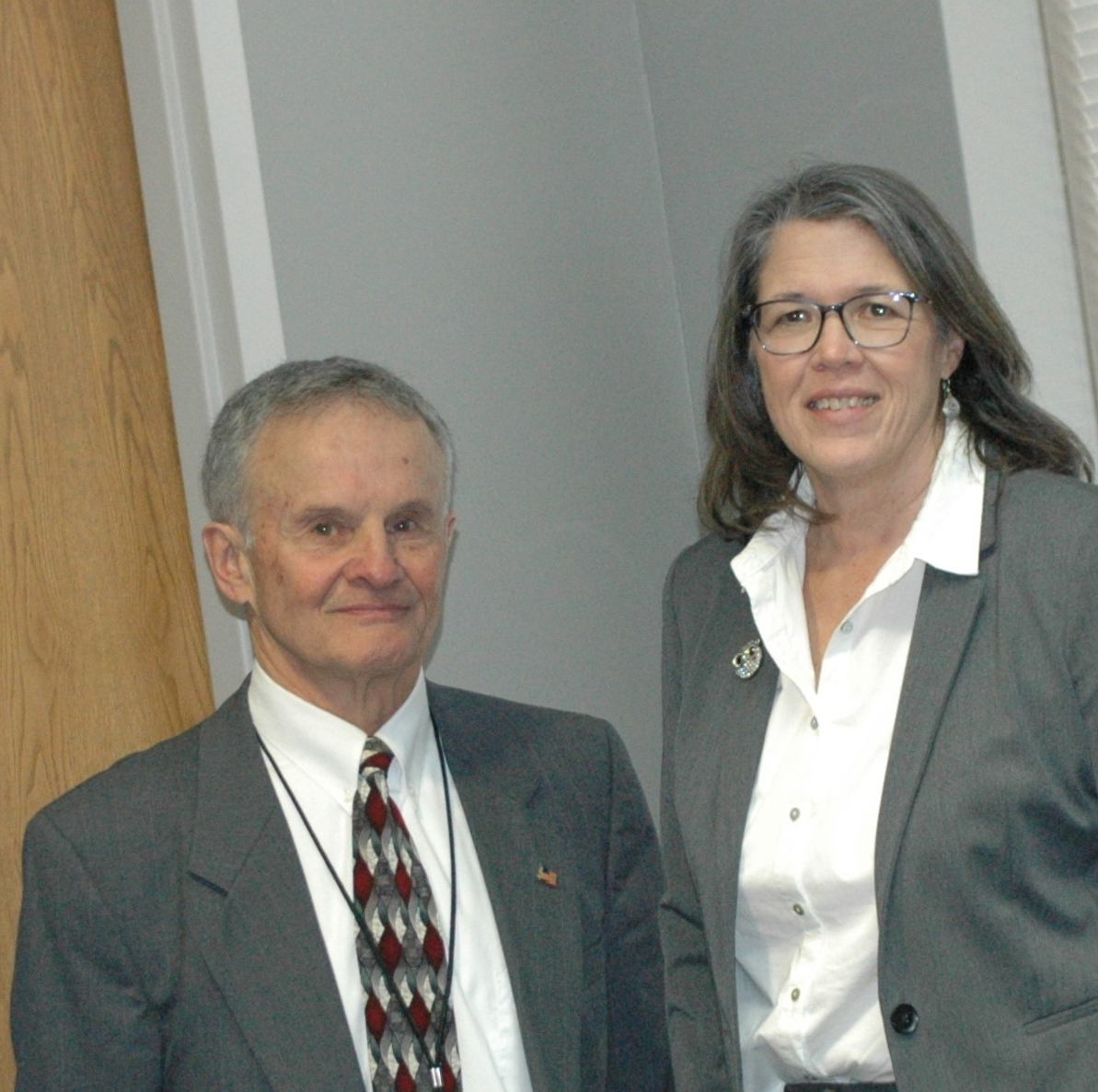
    Bill Smith, the current board chair, will finish his second year as chair in January and his term ends May 1, 2025. The board’s vice chair, Marcy West, also has her term expiring on May 1.

The NRB terms for Bill Smith and Marcy West will end May 1, 2025. Photo by Tim Eisele

    Both have the most experience on the board, serving during the turmoil while five of Governor Evers appointees (Sharon Adams, Dylan Jennings, James VandenBrook, Sandra Dee Naas, and Todd Ambs) were nominated but failed to be confirmed by the Republican-controlled State Senate.

    Most any observer will tell you that Smith has provided stability and dignity as board chair during unsettling times.

Some may consider the DNR administration

more important than the NRB, but the NRB is truly the public’s access point.  It is where biology and sociology come into the mix.

    We need strong, dedicated board members with a passion for natural resources!

    Even if Smith and West were to be reappointed by Evers, AND willing to serve again, would the Senate confirm them?

Both Smith and West were confirmed by the Senate’s Natural Resources Committee, chaired then by Sen. Cowles who had a deep interest in natural resources.  More recently the Senate Committee on Financial Institutions and Sporting Heritage now handles confirmations, and has a track record of turning down qualified nominees.

     Many citizens don’t realize that the NRB is comprised of volunteers who spend personal time going through briefing material, meeting with members of the public, attending public meetings and actively working at nine monthly meetings where they make decisions that can always make some happy and others upset.

Though new board members have indicated they are quick learners and have long-term interests in natural resources, the board lacks the long-term experience that many past boards have had when members were re-appointed to consecutive terms.

The board’s influence has been limited to setting policy and approving rules, since then- Gov. Tommy Thompson enabled the legislature to approve a budget that moved the Department of Natural Resources (DNR) into the governor’s cabinet. Now each governor appoints the secretary of the DNR rather than as it had been since the 1920s when the citizen board (or back in earlier days a citizen Conservation Commission) appointed the secretary.

Having the agency secretary serve at the pleasure of the citizen board was just an extra step to keep the position away from a more direct link to partisan politics. 

Political appointees bring with them political interests, and under Scott Walker’s term as governor he turned additional DNR positions (chief lawyer, public information director, and legislative liaison) into appointees rather than civil servants.

Secretary concerns

Following a short stint as DNR secretary, Adam Payne resigned after less than 12 months on the job a year ago, and the secretary’s position has been filled ever since by an acting secretary.

It is fair to assume that someone (Acting Secretary Steven Little) who has his own responsibilities as deputy secretary and now has to cover the full-time secretary’s responsibilities, one of which includes being the highly visible cheerleader for the department and strong advocate for natural resources, is unfair to both positions.

And, there are “questions” about a lack of follow-through by the DNR.

One that comes up at each NRB meeting is a petition filed on behalf of 232 citizens in February, 2024 to encourage a home rule on lakes to help prevent invasive species from being moved from lake to lake by boats.

According to attorney James Olson, the petitioners still have no response from DNR.

Their request is based on a 2008 DNR requirement that all water must be drained from

ballast systems upon leaving a body of water to prevent the spread of invasives from one body of water to the next.

The petition asks the DNR to enforce the regulation, but there is no response!

DNR, and the NRB, have also fallen down on appointing representatives to the Sporting Heritage Council, an organization created by the Wisconsin legislature in 2011 and coordinated by DNR.

The Council has not met since 2022, and the NRB is supposed to appoint representatives to discuss ways to continue the traditions of hunting, fishing and trapping into the future.

Some who served on the past council say they felt their time was wasted, yet there is no recommendation by DNR for new appointments to continue a council established by the legislature.

Public members consistently appear before the NRB with concerns about what chronic wasting disease is doing to the deer herd and Wisconsin’s tradition of deer hunting.  While “Rome” burns, DNR plods along with its plans for reviewing the old plan. Meanwhile CWD spreads to new areas and existing areas see higher percentages of CWD-positive deer.

Hunting licenses pay the bulk of the traditional conservation budget, and as license sales decline the question is who will pay for natural resources management in the future?

Legislative foot-dragging

2025 will bring a new legislature and a new state budget.  We can expect continued bickering over whether or not to increase funding and positions to DNR and whether to refund the Stewardship Program.

The state Supreme Court has ruled that when the past legislature funded Stewardship the Joint Finance Committee could no longer continue with its secretive vetoes which stalled the purchase of many acres of land for the public.

Knowing that, some legislators have threatened to reduce funding for future Stewardship projects.

The legislature will also wrestle with how to restore forestry funding to the amount they promised, and fund the fish, wildlife and law enforcement account that hasn’t had a general license increase for residents since 2005.

Although the state budget is balanced, they do it by eliminating positions or forbidding agencies to fill positions and then the Department of Administration says vacant positions aren’t needed and eliminates positions.

Cities that used to have several wildlife technicians now have none. According to the Legislative Fiscal Bureau in 2023 DNR had 2,511 positions, while back in 2002 it had 2,965!

The State Park Program used to be funded by state taxes, but no longer.

According to the Friends of Newport State Park: Prior to 1995, state parks were funded equally by GPR, fees, and other funds butthe all GPR funding for the parks was eliminated by the 2015-17 budget, according to the Legislative Finance Bureau. That’s one reason why Wisconsin spent only $19.6 million in 2017 to operate its state parks, or $1.08 per visit, which according to annual surveys from the National Association of State Parks Directors was the lowest in the country.

And, complaints from some past DNR law enforcement employees about bias have never been publicly answered by the DNR or investigated by an agency outside of state government.

Had enough?  Wait. . . it’s no secret that DNR operates with cooperation from federal agencies and some federal funds.  With new emphasis from a new president and administration that portends to cut massive numbers of federal employees, (which we can assume will impact EPA and US FWS, including possibly funding for habitat improvement or the Conservation Reserve Program in the Farm Bill), that could result in fewer employees and less money to work on behalf of natural resources in Wisconsin.

It seems that Charlie Brown’s friend, Linus, has walked into Wisconsin with the proverbial cloud over his head. And, these dark clouds could turn into a gully washer.

Public Intervenor, Wisconsin’s Loss

Madison, WI.—What Wisconsin lost in 1995 was on full display in Madison at an event celebrating the return of Tom Dawson to Wisconsin on October 1, 2024.

    Dawson served as the Public Intervenor for the State of Wisconsin from 1976 to 1995 and was instrumental in helping to prevent environmental damage from metallic mining, damage to ground and surface water, and limitations on public rights.

Tom Dawson (left) and Peter Peshek recall their work as Public Intervenors. Photo by Tim Eisele

    The 74-year-old Dawson, now residing in Hawaii, also taught classes at the UW-Madison Law School  

    The Public Intervenor’s office has been described as a “watchdog” that advocated on behalf of citizens by taking on mining operations, wetland drainage, use of DDT, and defending Wisconsin’s Public Trust Doctrine.

Unfortunately, in 1995 then-Governor Tommy Thompson eliminated the Office of the Public Intervenor in his state budget, while he also eliminated the independence of the Department of Natural Resources (DNR) by making the DNR Secretary a part of his cabinet rather than being hired by the citizen Natural Resources Board.

    The State’s reputation as an environmental leader has suffered ever since.

    Dawson followed in the footsteps of other legal scholars, including Peter Peshek from 1976 to 1983 and Kathleen Falk from 1983 until 1995.

    The three were known as the “trio of trouble,” for their advocacy on behalf of Wisconsin’s natural resources and resisting efforts of those who would pollute groundwater and restrict public rights.

When the office of the Public Intervenor ended, Dawson went on to become director of the environmental protection unit of the Wisconsin Department of Justice, where he helped enforce environmental protection laws and represented the DNR in litigation.

    Peshek went on to become the leading environmental attorney in Madison at Dewitt Ross and Stevens from 1983 to 2017.

    He was instrumental in writing the state’s new wiretap rules, which helped to bring down an organized crime ring in Milwaukee, and also helped to locate the killer of a DNR wildlife technician.

Falk went on to serve as the Dane County Executive from 1997 to 2011 and was inducted into the Wisconsin Conservation Hall of Fame in 2022.

What Wisconsin lost

    Many citizens today don’t remember that when then Governor Warren Knowles formed the Kellett Commission in 1965 to study state government, the result was a law that combined the previous Conservation Department with the Department of Resource Development to become today’s DNR.

It also formed the office of the Public Intervenor in 1967 to serve within the Attorney General’s office.

    The Public Intervenor was meant to do just that: intervene on behalf of the public on legislative and legal matters.

    Peshek, today residing in Sturgeon Bay, said that the office was an idea advanced by the hunting and fishing community.

Hunters and fishermen paraded around the square in Madison to show that they didn’t want conservation to be overshadowed in the new DNR.

    “Some of the issues we dealt with were directly related to hunting and fishing, such as expanding the Canada goose hunting zone,” Peshek said.

    Most of the time the issues the Public Intervenor worked on, such as wetlands and groundwater, were indirect but incredibly important to hunters and trappers, Peshek said.

    Peshek said that they were able to work with business and manufacturing organizations through a process of “consensus resolution” so that industry knew the mutually agreeable parameters they needed to meet in order to stay in business without harming natural resources.

    Jodi Habush Sinykin describes the history of the Public Intervenor in the Marquette Law Review, as: “protecting public rights in the state’s natural resources and to ensure fair play and due process for matters of environmental concern.”

    The beauty of the office is that it was independent, and worked under an advisory committee of environmental activists chaired by Arlen Christianson.

    Dawson won a major legal case (the Town of Casey in 1991) that allowed townships to regulate pesticides. In the case, Dawson won a 9-to-0 verdict by the U.S. Supreme Court that reversed a Wisconsin Supreme Court decision.

    Peshek said that the office was overwhelmed until Dawson came onboard, though Peshek had helped to write a new wire-tap law that helped solve the murder of a DNR wildlife technician and reduce organized crime in Milwaukee. 

    “His interests were on criminal law, which gave him the tenacity to endure pain and to cause pain,” Peshek said.

Kathleen Falk said that when she came to the Intervenor’s office, she met brilliant lawyers who saw the big picture and evidentiary detail.

  “All have different skills to offer, and we need all of us to get the job done,” Falk observed.

    At the time they were the only full-time environmental lawyers, and they forged a progressive track record of environmental defense, which caused Gov. Thompson to eliminate the office on behalf of the business community.

    To help offset some of the loss, the non-profit law firm of Midwest Environmental Advocates was formed in 1999 as a public interest law firm and has served as an advocate for the environment in the void of the Public Intervenor Office.

    Dawson said that he didn’t know if the Office of the Public Intervenor will ever return, but in the meantime the Midwest Environmental Advocates is doing important work.

    “I thought if it would come back, it would be soon after it was abolished,” he said.

    “The office threatened a lot of Thompson’s business supporters.  We were successful and winning cases and effective with the legislature.”     Those were the golden years, when Wisconsin had an Office of Public Intervenor and an independent DNR.

Two Great Professors

Madison, WI.—Aldo Leopold’s A Sand County Almanac should be considered the environmental primer of the 20th Century.

    October 27, 2024 is the 75th anniversary of the publication of this literary classic.

    The book, printed in 15 different languages, with more than two million copies sold,

involves a look at events in the natural world as the calendar turns each month. 

Its following series of essays help to unlock secrets of the natural world.

    In 1933 Leopold began work as the first professor of wildlife management at UW-Madison. He was the first such professor in the nation, and was a skilled writer.

    He submitted his essays for publication in a book, at first being turned down by at least two publishers, but then receiving acceptance from Oxford University Press April 14, 1948.

    Soon after receiving the good news, Leopold was up at his cabin on the Wisconsin River near Baraboo, where he often made field notes that were eventually turned into eloquent essays, when he was alerted to a wildfire consuming his neighbor’s property.

    He rushed out and in the midst of fighting the fire succumbed to a heart attack on April 21, 1948.

    When Leopold’s class in wildlife management met the following week, it was Joseph Hickey, assistant professor of wildlife management, who entered the classroom to inform the students that “The Professor” would not be there as he had passed away that weekend.

    While Leopold had undoubtedly been pleased with the earlier news that his book (which he titled Great Possessions, and the publisher later titled A Sand County Almanac) would be published, there still were details to work out.

    Curt Meine, Leopold biographer and senior fellow at the Aldo Leopold Foundation in Baraboo, writes that the job fell to one of Leopold’s sons, Luna, to pull together the details with the publisher along with other close colleagues.   

    One of those colleagues in Madison was Prof. Hickey, who according to a note from Nina Leopold Bradley, Leopold’s daughter, referred to Hickey as Leopold’s favorite student.

Prof. Joe Hickey shared his respect for the late Aldo Leopold on this field trip, attended by the author, in 1969. Photo by Tim Eisele

    Hickey’s role in helping with publication of A Sand County Almanac is not as well known.

    Hickey and his wife Peggy, were good friends of Estella and Aldo Leopold, and in fact when the Hickeys were married in Madison, Aldo and Estella were the only other observers and served as best man and matron of honor.

    The Joseph J. Hickey archives at the Steenbach Library in Madison reveal Hickey’s admiration for Leopold, once observing that “Leopold was not only a thinker, an Olympian, but a great teacher.”

    Hickey recalled telling Leopold: “Aldo, you should not waste your time on research, you should be writing these essays for us.”

    Hickey was on the faculty in Madison at the UW Department of Wildlife Ecology and on April 22, 1948 Hickey received a letter from Oxford University Press expressing shock that Leopold had passed away.

    “I don’t know now what happens to the book,” Oxford editor Phillip Vaudrin wrote. “He (Leopold) was going to spend the summer working it over and getting it into final shape – a job which he alone would have been able to manage, I should have thought.  Perhaps you could let me have your thoughts about this?”

    Hickey later received a letter from Luna Leopold on April 30, instructing Hickey to “take the responsibility for making some suggestions for an agreement” with the book illustrator, since Hickey had experience having published his own book A Guide to Bird Watching in 1943.

    It perhaps was not a coincidence that Hickey’s earlier book was also published by Oxford University Press, so the Leopold family knew he could provide valuable advice and Oxford University Press knew they could rely on Hickey.

On April 27, Hickey wrote to Professor Chapman at the Yale School of Forestry (where Leopold had graduated from) that, “He (Leopold) had hoped to retire in 1950 and clean up this unfinished business, but that job is now left to other hands.  We are negotiating with Oxford University Press for publication of a volume of new essays which they had verbally agreed to print in the fall of 1949.  I have good hope that this deal will go through.”

The deal did go through, and in honor of the 75th anniversary people can purchase the book at a special price of $7.50, from the Aldo Leopold Foundation at:

Buddy Huffaker, executive director of the Aldo Leopold Foundation, summarizes the book by saying, “I believe A Sand County Almanac continues to inform and inspire conservation, and conservationists, because the book invites the reader on a journey to learn more about how ecological systems work, then diagnosis conservation challenges, and finally presents a systemic solution – and ethic of care that depends on all of us to be realized.  And perhaps most importantly, it conveys all this in eloquent simplicity that stirs the heart and the mind.”

This is an important book, that should be in every library in the State.

Two Professors, Two Legacies

    “THE” Professor.  That was how the late Aldo Leopold was regarded by his students

Today he is known nationwide as the father of modern-day wildlife management.

His insights to natural events gained as professor of Game Management at UW-Madison, and while restoring land at his “shack” on the Wisconsin River, helped spark interest in the natural world through his book:  A Sand County Almanac.

    For me, “THE” professor was Leopold’s chief graduate student: Joseph J. Hickey, who opened doors to the natural world for hundreds of students just like me.

    As a graduate student in Prof. Hickey’s Wildlife Ecology 318 class the Spring semester of 1969 at UW-Madison, A Sand County Almanac was required reading, and which I believe should be attached to every birth certificate in Wisconsin!

Walking in Hickey’s footsteps on our class field trip to the Leopold Shack that semester brought insight to Leopold’s efforts to heal “worn out” land and his final moments before he died there fighting a grass fire in 1948.

    Hickey was a direct link to Leopold, as he was personally recruited to come to Wisconsin by Leopold to work as his graduate assistant in 1941.

    A New York native, Hickey had met Leopold at a cocktail party in New York.  After that chance meeting, he left his fiancée (Margaret “Peggy” Brooks) in New York and drove to Wisconsin in November, 1941.

    Hickey wrote three letters a week to his beloved Peggy, describing his impressions of being in Wisconsin for the first time, his work as a graduate student (“bringing a fresh point of view to the solution of an old problem” studying severe erosion of farmland in the Driftless Region), and his mentor: Aldo Leopold.

    In those early Madison days, he writes that rooms are $3.50 a week and meals are $1 a day.

Hickey’s office was in the attic of the building where Leopold had his office at 424 University Farm Place in Madison.  That building, not far from the current Babcock Hall, has since been torn down.

    Hickey’s letters describe an immense admiration for Leopold’s understanding of natural systems and how he encouraged students to question how things evolved.

Hickey insights

    Hickey wrote that Leopold meets with each of his graduate and undergraduate students at least once each week.

    Besides classes, students participated in regular “bull sessions,” where they exchanged ideas with the professor.  Those sessions often stretched into the evening, and always present were apples.

    “Leopold has the nice habit of treating one as an intellectual equal and not as a hireling.  Students with ideas are listened to, not shut off,” Hickey writes.

Hickey surmises his two years in graduate school will be a symbiotic relationship, with Leopold extracting ornithological knowledge from Hickey, just as Hickey will draw knowledge from Leopold.

    In December, 1941, Hickey accompanied Leopold and Mrs. Leopold, Estella, and 14-year-old daughter, Stella, up to his shack 50 miles northwest of Madison. 

    On the outing Hickey relates that, “Leopold is a revelation in the field.  Plant and animal ecology just drip from him and I felt like a boy being taken into the woods for the first time.”

    Leopold expounded on how prairie grew up here and woodland there, why some trees are short and others tall, why grouse can be found in the next patch of brush, and why there was only one deer in the area.

    Another time up at “the shack,” Leopold attempts to live-trap and band chickadees, and while waiting to catch chickadees Hickey briefed Leopold on ornithological research out East.

    Hickey, an accomplished ornithologist who in 1943 wrote the book A Guide to Bird Watching, writes to Peggy that on the ride back to Madison, Leopold said: “Joe, we’ll have to have these ornithological seminars again.”

    Hickey’s master’s project involved researching a solution to erosion in western Wisconsin, caused by pasturing of cattle in woodlands and row cropping.  This was part of the nation’s first project by the Soil Conservation Service at Coon Valley to solve erosion problems. 

Leopold was brought into the problem, Hickey writes, because people in Madison theorized the resulting actions could provide good hunting.

    In June, 1942 Hickey and Leopold drove up to LaCrosse County where Hickey is researching erosion problems on farms.

    Hickey writes: “The trip up is really something.  AL taught me flowers and grasses and I taught him bird songs.  He showed me all kinds of plant relationships, and I showed him a few tricks in songbird censuses.  My head is dizzy with new things.”

    When Prof. Hickey and Peggy were married in Madison in 1942, Aldo and Estella Leopold were the only other participants at the wedding.

When Leopold died of a heart attack in 1948, while fighting a grass fire near his shack on the Wisconsin River, Hickey became chair of Leopold’s department.

    Later Hickey, a renowned ornithologist, led the fight to ban the use of chlorinated hydrocarbon pesticides known as DDT, when it was discovered they caused thinning of egg shells of peregrine falcons.  Falcon populations plummeted and dead songbirds were found belly-up on front yards after DDT was sprayed.

    His efforts were controversial, as the agricultural industry, and Ag faculty resisted. Fortunately, DDT was outlawed in Wisconsin in 1970, prior to its national ban in 1972.

    Hickey passed away in 1993 and his ashes were interred on the Leopold property by the “shack.”

    Two professors, two legacies that left big marks on Wisconsin.

State Senate continues partisan politics

Nothing new in Wisconsin, as the GOP-controlled legislature continues to play hardball, rather than cooperatively working to allow citizen boards to keep politics at arm’s length from state agencies.

The Senate Committee on Financial Institutions and Sporting Heritage revealed its partisan agenda when it voted not to confirm four appointees to the Natural Resources Board, and that vote was upheld by the GOP-controlled State Senate.

The Senate effectively fired the four NRB appointees of the Governor, and he quickly appointed four new citizens to the NRB.

All the votes followed partisan lines, except that Republican Senator Robert Cowles did vote to allow the Governor’s appointees to serve, saying the governor had that right.

From a diverse viewpoint, the Senate turned down a black woman, a woman from northern Wisconsin, a white male, and a person with ties to and representing Native Americans, though it did recommend confirmation of a white male who represents the agricultural arena.

What happened to ideology that the Natural Resources Board/Conservation Commission should represent a diversity of backgrounds of citizens who are concerned about natural resources and the environment?

The goal should be to confirm people who want to do the right thing by setting natural resources policies for future generations.

Legislators indicated the four nominees who were NOT confirmed, were appointed by the governor because they shared his progressive agenda and would have voted in favor of the Department of Natural Resources’ proposed Wolf Management Plan.

When the Senate committee held a public hearing on the original nominees, three of the five indicated they didn’t think the state needed a hard number on wolf population limits, while another hedged her answers to the committee.

Is it any wonder why a nominee would give a truthful answer knowing that they will be rejected if they don’t give an answer desired by the committee?  If so, this is pay-to-play, rather than sifting and winnowing for dedicated public servants.

Was it also a major stalling factor as the Republican legislature tries to keep tight control after losing an election for governor, attorney general, and a recent Supreme Court judge who appears to take a more progressive view on issues?

The DNR staff, which is supposed to present its recommendations based on science, recommends the plan without a fixed population goal allowing the state to manage the population based on yearly changes.  This is similar to what DNR is doing now with deer and bears.

Past history has shown when DNR issues hard population estimates, critics come out of the woodwork and the estimated numbers do nothing but attract fire from opponents.

Again, politics becomes an important cog in the wheel of natural resources management in Wisconsin.  It didn’t use to be that way.

Had the committee found a problem with one person there might be some reason to think it was a lack of natural resources background, but firing all four just confirms the smell of politics.

For instance, Sandra Dee Naas was not only a hunter and angler, but she is a certified trapper education instructor, serves as an Ag and Natural Resources instructor at Ashland High School and owns an environmental consulting firm in Ashland.

Was the fact that Naas did not receive the committee’s support for confirmation pay-back because the previous DNR administration invited Naas to make reports at the NRB meetings when then board member Dr. Fred Prehn refused to step down at the end of his appointed term and continued serving (the first time that ever occurred on the NRB)?

At subsequent NRB meetings the Secretary invited Naas to give a report during the Secretary’s comment time, which could have been seen as an “in your face” move to the Republicans, since Naas was appointed by a Democratic governor.

Jim VandenBrook served as the executive director of the Wisconsin Land and Water Conservation Association for six years, and water quality section chief of the Department of Agriculture, Trade and Consumer Protection for 26 years.

Dylon Jennings brought in the perspective of the Native American population, and Sharon Adams, perhaps had the least background in traditional hunting/trapping experience, but is experienced in fishing and is involved in bringing new groups of people into natural resources.  This has been a major effort of the DNR and NRB in trying to attract new people to natural resources, and offset the loss of license revenue as “traditional” hunters and anglers age out.

When we look back at previous NRB members, we have seen many average people who had the opportunity to make a contribution and help set policies for natural resources in Wisconsin.

Adams would be only the second African American to serve on the NRB and Jennings would have been the first Native American.

Is there any reason other than pure partisan politics why four of five nominees didn’t get the chance to represent their constituencies and bring new perspectives to natural resources policies?

The State Senate saw a wolf lurking in the back of the room, but front and center was plain old partisan politics, which should be put on the list of extirpated species.

Roseate Spoonbill: only the second Wisconsin sighting in over 100 years.

Per the Madison Audubon Society’s Facebook post August 16, 2023.

Tim and Linda Eisele, Madison Audubon members and volunteers, reported the second modern record for a Roseate Spoonbill in Wisconsin on Saturday, August 12. They found the bird while kayaking the Crawfish River in Jefferson County.

The first spoonbill observation in the state was reported in 1845 and recorded in “Wisconsin Birdlife” by Sam Robbins. The first modern record was reported near Green Bay on Cat Island (closed to public access) by Logan Lasee on July 26, then observed at the Ken Euers Nature Area up until August 4. It’s been fascinating to see the rare species people have reported in our state all summer long!

It’s NOT about Prehn, it’s the SYSTEM!

It’s NOT about Dr. Prehn.

    The controversy over Dr. Frederick Prehn and his position on the Natural Resources Board is not about Dr. Prehn.  It IS about the system.

    The system is broken in Wisconsin, we know that, and what was supposed to be a system of checks and balances to keep politicians out of natural resource management is now controlled by partisan politicians.

    Don’t be confused, Dr. Prehn is an avid hunter, fisherman, and has a long family history of hunting.

    He directed the DNR to put more emphasis on the future of big game in this state, and re-start the dormant prairie chicken management plan.

    The problem is that he continues serving in a position on the NRB which expired in May, 2021 and he has not been re-appointed to that position.

Now that Wisconsin’s Supreme Court has ruled that he can stay in that expired NRB seat until the State Senate confirms his replacement, he has proven his point.

Granted, it’s hard for an outside observer to understand how a Supreme Court justice can question whether the position actually expired when Prehn’s appointment specifically ended May 1, 2021.

Someone needs to tell the court that, “If it walks like a duck, quacks like a duck.. . It’s a duck.”

The State Supreme Court, similar to the U.S. Supreme Court in its recent West Virginia vs. EPA decision, is playing with fire trying to decide what power lies with the legislative branch and what is the responsibility of the executive branch.

Powers are supposedly co-equal, but it appears the courts are turning away from science.

The System is undermined by politics

What has happened is that ugly hard-ball politics are pulling the strings behind the curtain.

The State Senate, which had 14 months to interview Prehn’s replacement and confirm a new person, has not done its job.

An isolated instance?  Not hardly.  The Senate has also not confirmed Gov. Evers appointments to the Board of Regents, and according to the Governor’s Office, more than 100 other appointments to positions and boards are unconfirmed.

There is no doubt that the Republicans in control of the legislature are ignoring their responsibility and not confirming appointments in hopes Governor Evers will be defeated in November, and a new Republican governor will then appoint conservative board members which the legislature will quickly confirm.

The Wisconsin State Journal reported that documents show past Republican governor Scott Walker wrote to Dr. Prehn encouraging him to “stay on.”

This stinks to high heaven, and pulls the rug out from under the original concept of the Conservation Commission/Natural Resources Board where different governors appoint different citizens to boards providing a balanced look at natural resources.

    Some of the symptoms that are emerging include:

  • The Department of Natural Resources (DNR), which used to carry out direction by the Natural Resources Board, now takes those actions “under advisement.”
  • The  board, which sets policy for the DNR, now cares more about the advice from a deer “expert” from Texas than it does from biologists who designed what was thought to be one of the “best” SAK deer management programs in the U.S.  The board sides more with Wisconsin Manufacturers and Commerce weakening environmental regulations, such as PFOS, than with state health experts.
  • In the eyes of many conservationists, a natural resources board member is no longer seen as someone dedicated to natural resources, and the “side show” detracts from the importance, authority and image of the board.

Of course, it is not just Republicans that play games, as then Gov. Jim Doyle, a Democrat, ruled with an iron fist.  Doyle promised to sign a bill backed by conservation interests that would have allowed the NRB to appoint the secretary but when the bill finally came to him Doyle vetoed it!

Politics is not for the faint of heart, but it should not be responsible for destroying a system that worked for decades!

It’s time to move on, before Wisconsin’s democratic system of government crumbles, as the national system is now teetering.

Wisconsin needs

    This is the time for Dr. Prehn, who made his point, to show statesmanship and now step down, and let the system return to its democratic principles.  This would assure citizens that behind-the-scenes strings are not being pulled by Republican legislators, and Dr. Prehn is not just a pawn of the Republican legislature.

    If the current controversy continues, it could jeopardize the future of the existence of the board system.

Or if continued, when Democrats eventually have power we can expect similar disruptive, political non-action. 

    Greg Kazmierski, NRB chair, needs to show chairmanship-type leadership to the board he leads and bring a proposal to the board that would ensure future uninterrupted functioning.

The board uses a system of Manual Codes to outline its procedures, and they need a code where every board member, and all new board members, agree to serve their term and vacate their seat when done unless they are re-appointed by the Governor to serve again.

Such a code could lead to a smoother functioning board and eliminate future distractions from either political party.

    The Gov needs to appoint a commission, not unlike the Kellett Commission appointed by former Gov. Warren Knowles, to right and revamp the system, so that conservationists get the representation and input they deserve.

    The Gov also needs to announce new board appointments in March or early April, giving the Senate time to review appointees and confirm or deny them by May 1.

The legislature needs to pass a law that if new appointments are not confirmed within one month of when they should have taken effect, that the new board appointee is allowed to serve until that appointment is taken up by the Senate and either accepted or rejected.

    July is usually the time for celebration of America the Beautiful.  Let’s see if we can celebrate America’s democratic system, and Wisconsin’s previously respected system of citizen board oversight, by returning to principles esteemed by conservation leaders such as Aldo Leopold, William Aberg, and Haskell Noyes.

    What’s taking place now is a perversion of the system, and a return to the days of the early 1900s when political bosses pulled the strings.

Note:  Tim Eisele has followed NRB members and meetings since 1971

Politics are Taking Over Wisconsin’s Natural Resources

The system is out of whack.  We know that.

    The legislature is creating natural resources laws, rather than relying on the organizations they created to manage natural resources and recommend needed laws. 

    The Natural Resources Board is adopting regulations that are not backed by science provided by the Department of Natural Resources (DNR).

    The DNR is ignoring direction and votes of the Natural Resources Board.

    And, the governor seems to be placated by business as usual, though it’s obvious he is fighting to just “run” the state while the legislature does everything it can to fight against him.

    There is NO kumbaya in Wisconsin!

    How much is due to politics and how much is due to the general malaise, unhappiness and divisiveness within the country is unknown.  But you wouldn’t be wrong if you guessed the odds are 99-to-1 in favor of politics.

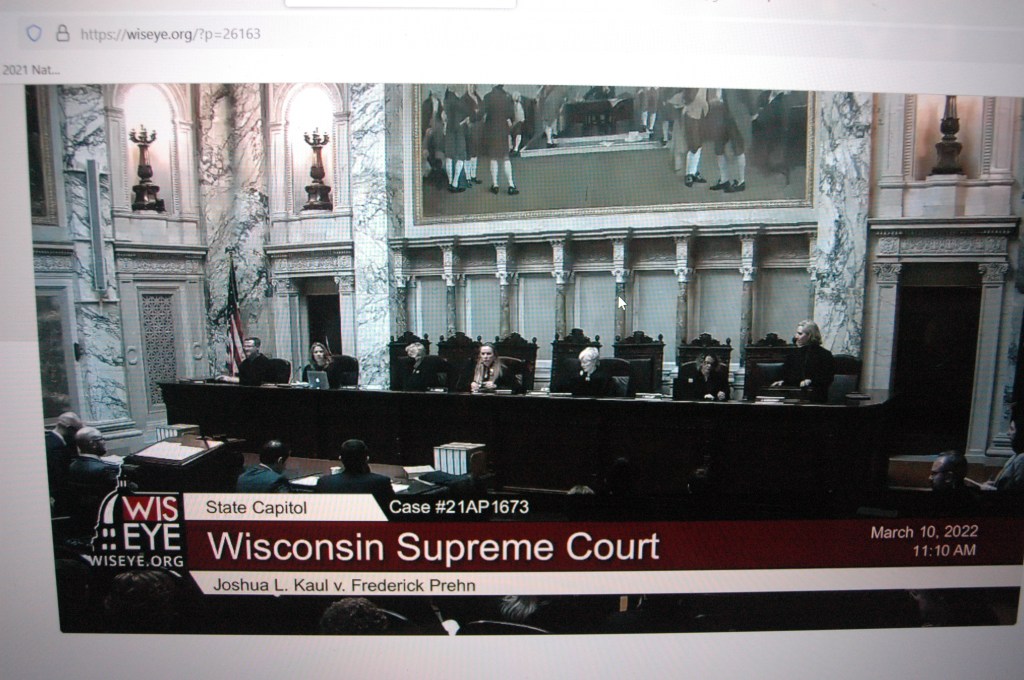
    Now, the Supreme Court of Wisconsin is hearing the case of the Attorney General against Dr. Frederick Prehn who continues to serve even though his term on the NRB ended.

Wisconsin Eye records the Supreme Court meeting in the case of Attorney General Joshua L. Kaul vs. Dr. Frederick Prehn. Photo by Tim Eisele

    Prehn was appointed by then-Gov. Scott Walker and he is one of four NRB members who were appointed by Walker and create a majority of conservative thinking.

     Board members generally are committed to doing what they feel is right for natural resources and the citizens of the state, but when they vote to ignore health standards and scuttle restrictions on pollutants (which are endorsed by the pro-business Wisconsin Manufacturers and Commerce), there is cause to wonder:  who are they representing?

    How can families, especially with young children, believe that the NRB has their best interests, when it ignores advice from the Department of Health Services in setting acceptable levels of contaminants?

    Synthetic chemicals such as PFAS do not break down in the environment for extremely long periods of time, they accumulate in the human body, fish and wildlife.  Exposure to PFAS may cause adverse health effects in humans!

    It would have been unthinkable years ago to accept that communities in this State have to get their drinking water out of plastic bottles.  But that is occurring now.

    It’s understandable that the board is heavy toward the conservative side, when appointed by a Republican governor, and at times toward the more liberal side when appointed by a Democrat governor.

    But generally past boards have congealed to “do the right thing” to protect the health of citizens.  That is no longer true.

    It is also clear that partisan politics has clearly come to the fore when the legislature finished its recent session and completely failed in its responsibility to hold a hearing that would have given it the opportunity to confirm, or deny, the newly appointed replacement for Dr. Prehn.

    This was a session that didn’t have to deal with a new state budget and it had plenty of time to hold hearings and do what it is mandated to do.  It completely whiffed, and it is now obvious that the Republicans in the legislature did NOT want to hold a hearing and thus allowed Dr. Prehn to stay on the board.

    The Attorney General filed a case with the Supreme Court, which heard oral arguments on March 10 and should issue its ruling by June 30.

    The justices’ questions were interesting, with Chief Justice Patience Roggensack, appearing to represent the majority, questioning whether a vacancy actually does exist.

    Prehn’s six-year term ended on April 31, 2021 and he has stayed on because the Senate has not yet confirmed the new appointee (Sandra Dee Naas), and Prehn bases his ability to stay on based on a 1964 court decision.

    Normally in the past an expiring board member would vacate the seat, allowing the newly appointed – but not yet confirmed – person to take his or her seat until they are confirmed or rejected.

    Yet, questions by Justice Jill Karofsky and Justice Rebecca Dallet were interesting, wondering if Prehn’s seat is not considered vacant, then the Senate just doesn’t have to hold a hearing and these board appointments could be essentially life-time appointments.

    Justice Brian Hagedorn even intimated that, based on the state Constitution, the governor has only limited ability to make appointments.  He wondered if the ability to make appointments belonged to the legislature.

    No matter what the decision is by the court, the system will still be broken.

If the court rules in favor of Dr. Prehn, he will be allowed to continue voting into 2023 or 2024 when a different legislature meets, and the system of staggered terms set forth since 1927 by founders such as Aldo Leopold, William Aberg and Haskell Noyes, Sr., is “roadkill.”

If the court rules against Dr. Prehn, he gamed the process by participating in votes and decisions that ignored and weakened advice from the Department of Health Services and DNR when he should have vacated his seat.  And, if his replacement eventually takes his place, she will have lost a full year of her term to participate and vote.

In addition, the rancor has taken attention away from natural resources problems, and brought an ugly stain to the reputation of the citizen board.

    One observer, Peter Peshek, respected retired environmental lawyer, has opined that the governor should show some leadership and organize a blue-ribbon commission to recommend changes to help put the natural resources train back on its tracks.  Peshek has even recommended five names of leading citizens with diverse backgrounds (George Meyer, Dr. Christine Thomas, John Torinus, Jr., Tom Diehl, and Kathleen Falk) who could take on that challenge.

    Meanwhile, our state’s natural resources system continues to be railroaded.

We should have been able to keep our eyes on the ultimate goal of always working to do better for the resources of this state.

Just because Hunters can, do we need to?

I do everything because I hunt.

Hunters, in general, have been dedicated conservationists, and they have been the financial and vocal support for natural resource programs that have sustained many resources, including many non-game and endangered species.

Hunters have been fortunate to have had forefathers the likes of Teddy Roosevelt, J.N. “Ding” Darling, and Aldo Leopold, who helped establish systems and standards that have guided our hunting heritage.

But, that is not to say that all hunters and all hunting is right or correct.

Wisconsin is now in the midst of pressure from an out-of-state Hunter Nation that is no help to the image of hunting and hunters, just as is Ted Nugent when he appears in public as an advocate for hunting.

Let me 100% clear, Ted Nugent and Hunter Nation do NOT speak for me and I think they portray (with the constant goal of kill-kill-kill and liberalize every hunting season) the extreme worst examples of hunters as totally me-oriented!

Hunting is much more than killing, it is all about the experience of being outdoors and having a QUALITY and ethical experience.

Eliminating the requirement for new hunters to have to pass a field test demonstrating that they can handle firearms responsibly, is short-sided. Hunter education has helped to reduce hunting accidents tremendously and having someone demonstrate that they can handle a firearm, keep their finger off the trigger and point the muzzle in a safe direction should be mandatory for every new hunter.

Opening a season to hunt sandhill cranes in Wisconsin is a mistake, and will just turn more people who are non-hunters against hunting and hunters.

The vast majority of the voting population are non-hunters (which is much different than anti-hunters) who allow hunting to continue as long as it is managed professionally and with ethical behavior.

Sandhill cranes are an iconic species that have come back from near extinction and are welcomed by many. Biologists have determined that opening a hunting season will make no difference on cranes that damage farmers’ crops in the spring.

Yet, Hunter Nation and the conservative right are trying to portray these changes under the guise of being pro-hunter, pro-farmer, and being used to recruit new hunters.

We have many species to hunt in the state and opening a hunting season on cranes will do more to damage the image of hunters in the eyes of the non-hunting public.

Just because we “can” hunt sandhill cranes, does that mean that it is the right thing to hunt sandhill cranes? Will we lose more than what we gain?

Have we totally lost our compass of why we enjoy the outdoors and the fact that the natural resources are most important, and those of us who pursue the resources are secondary?

Events like contests where the person who kills the most rabbits or coyotes, sponsored by local businesses, have no business being called hunting. They should be outlawed.

Proposals such as allowing dog owners to turn their dogs loose on public lands during the nesting season, are poorly thought out. This could disturb nesting birds which are the main reason that many hunters own dogs to use for pursuing and retrieving game in the fall.

Disrupt nesting birds and there could be far fewer birds to hunt in the fall.

We put up with fenced-in deer farms, some of which are open to “hunting,” (if Wisconsin sportsmen were smart they would follow the example in Minnesota and buy out deer farms), we allow bars and organizations to host shooting contests that bring in the most coyotes or rabbits in a day and win prizes, we allow hunters to carry firearms that look like – but are not – repeating firearms that the general public considers as weapons.

I hunt with a firearm, not a weapon. Using a single shot, double barrel, over-and-under, pump action, semi-automatic firearm has worked for hundreds of years, why would we need the firearm that looks like an automatic weapon and antagonize non-hunters who are concerned about people carrying around “automatic weapons” in the fields, woods and marshes?

The phrase: “We have met the enemy and they are us,” has merit. It’s time to step back and look at ourselves, and see hunting and hunters as the general public does and return to our roots as conservationists who realize we need the support of hunters AND non-hunters alike to really preserve our traditions and manage wildlife for the future.

Legislators are Eviscerating Wisconsin’s DNR

The saying is, “If you don’t remember your history, it is bound to repeat itself.”
That’s often true and for those of us concerned about Wisconsin’s natural resources we are seeing history repeat itself.
Then
In the early 1900s, politicians passed laws involving natural resources, while they had no advanced education or knowledge of what should be done to manage the resources.
They went by the seat of their pants or by what their friends and financial supporters thought should be done.
Realizing that they needed a more “knowledgeable and unbiased” way of having the state’s natural resources managed, they established commissions to hire people with knowledge to run programs.
There was a three-man fish commission established in 1874, a three-man forestry commission in 1897, and a Conservation Commission in 1908 which was reauthorized in 1911.
The result was that the Wisconsin Conservation Department, with backing of conservationists, was created in 1927, to provide management with science-based knowledge.
The same exasperation with politicians meddling in natural resources was responsible for the establishment of the Wisconsin Wildlife Federation.
According to George Meyer, past executive director, The Wisconsin Wildlife Federation (WWF) was formed in 1949, after the then-governor Oscar Rennebohm rejected the deer hunting season that had been adopted by the Wisconsin Conservation Commission.
“He had a wealthy donor who thought he knew better how to manage the deer herd,” Meyer said.
The governor demanded that the Commission set the season the way his donor wanted, and sportsmen of the state were fed up and decided to get all of the various clubs together to have a voice.
“It was a rebellion against the political establishment,” Meyer said, noting that politics in natural resources never goes away.
The point was to have natural resources management decisions made by an organization that hired people who were trained in the natural sciences.
Now
Again today, legislators have become upset that they don’t have more control over how natural resources are managed, and they have been chipping away at authority the DNR used to have.
They’re clawing back any authority that used to be held by the DNR.
Opening dates of gun deer, fishing, and elk seasons? Now established by the legislature.
Regulations such as feeding and baiting of deer? Now established by the legislature.
Use of dogs for training to hunt bears? Now in statute by the legislature.
Apostle Island muzzleloader hunt? Set by the legislature.
A year-round open season on woodchucks? Set by the legislature.
Opening of the wolf hunt? The legislature set the original wolf hunting season to start Oct. 15, when pelts were not prime. They then had to correct the season to start Nov. 1.
Another case in point: Wisconsin has had
the Gaylord Nelson/Warren Knowles Stewardship program that allows the state to purchase available land for public recreation. That land could otherwise be sold and available to only the landowner, rather than available to everyone to hunt, fish, trap, cross country ski or hike.
But legislators, especially those in the north, are unhappy that land that could be owned by private landowners, and on the tax rolls, is now public land. They forget that the State makes payments-in-lieu-of- taxes to local units of government for land taken off the tax rolls.
They also forget that public land, much of which is located up north, also draws people from southern Wisconsin adding to the local economies.
The Stewardship Program used to be a 10-year program, and would have been as proposed by Governor Evers in his initial budget, but legislators discarded that and only passed a program good for four years.
They also put on additional restrictions, so that when the state does come to an agreement on land it still has to be approved by legislators, and if some isolated legislator decides to pull the rug out it stops the purchase cold.
And, yet on things that the legislature is supposed to be doing, such as confirming appointments to boards and departments, the legislature sits on its hands.
We have a state transportation secretary who is serving unconfirmed.
We had a state tourism secretary who served for more than a year unconfirmed.
We have a very big controversy over the Natural Resources Board chair who is serving because the State Senate can’t take the time to hold a confirmation hearing.
Legislators give as the excuse they’ve been working on the budget all year and can’t take up the confirmation process.
Yet, the group who makes the budget is the 16-member Joint Finance Committee which means that the remaining 116 legislators who are drawing $53,000 per year couldn’t take the time to hold confirmation hearings.
Give me a break!
Of course, Governor Tony Evers waited until the last minute to nominate a board replacement, who could have been nominated a month earlier giving legislators a month to hold hearings, since it’s well known that board member terms end May 1.
Politicians like to take their whacks at the DNR, and seem to enjoy picking apart the DNR to neuter its power. Past Gov. Scott Walker did that whenever he could, as he and then Sen. Tom Tiffany saw to it that the DNR science services section was emasculated.
And it’s not just Republicans who have pulled the rug out from under the DNR, as then Gov. Jim Doyle ran on a platform of returning the appointment of the Secretary of the DNR to the NRB, saying often: “Send me the bill and I’ll sign it.”
When the legislature did indeed send him the very bill he’d promised to sign, he vetoed it.
In the end we are seeing where biological knowledge and professional background of natural resource employees are not only ignored, but politicians are taking matters into their own hands.
We need to return management of natural resources to the DNR and really base it on science.
The past has become our future.